For Botswana employers · Second edition · 33 pages
The new labour law, explained.
The Employment and Labour Relations Act, 2025 has been in force since 1 September 2026 — Botswana’s biggest labour-law reform in a generation. This handbook covers what changes, what it means for your business, and what to do about it — in plain language, with every rule cited to the Act, its Regulations or the Court’s Rules, so you (or your lawyer) can check it.
PDF · 33 pages · one payment, by bank transfer
What changes
Six shifts every employer should know
From the handbook's one-page summary of the reform — each with the section of the Act it comes from.
Hospitalisation leave is new
A separate 20-working-day pool on top of sick leave — not carved out of it. When hospitalisation days run out, the ladder is sick leave, then annual leave, then unpaid.
s.220(2)
Leave expands substantially
Maternity becomes 14 weeks at not less than 70% of basic pay and other benefits. Paternity (5 days), adoption (10 weeks) and family responsibility (3 days) are new or newly explicit.
s.222 · s.226 · s.227 · s.221
Total deductions are capped at 70%
New at commencement: deductions under the Act's deduction provision — worker-agreed deductions, union dues, stop orders — may not add up to more than 70% of a worker's pay, so at least 30% stays in hand. Staff loans and court garnishees sit under their own sections; prudent employers keep the overall total under 70% either way.
s.197(1)
Fixed-term contracts get a real limit
No fixed term, or chain of them, beyond 12 months — unless you can justify it in writing, and the burden of proving that is yours. An unwritten reason is unprovable, and unprovable means permanent.
s.157
Dismissal becomes procedural
A nine-step disciplinary procedure is now statute, and the employer must prove every dismissal had a valid reason, a fair reason, and a fair procedure. A valid reason does not cure a broken procedure.
s.163
The burden of proof moves
In a dismissal dispute the burden is yours from the start — the employer must prove the reason and the procedure, no precondition. In a discrimination dispute, once the worker shows a basic case, you must disprove it. Your records stop being good practice and become the defence.
s.163(2) · s.27
The honest headline: for an employer already doing things properly, ELRA is mostly more paperwork and more leave. For one who dismisses informally, chains fixed-term contracts, or treats maternity as a favour, it is a step change in exposure — with the burden of proof against them.
Inside the handbook
Written to be used, not filed
Thirty-three pages, front to back in an evening — then four pages you'll keep coming back to.
The checklist
Thirteen actions in priority order — most cost time, not money. If you read only two pages, make them these.
The numbers card
Every figure in the Act on one page — hours, overtime, leave, notice, penalties. Pin it up.
The nine mistakes
The ways employers actually get caught, ranked — from dismissing poor performance as misconduct to letting probation lapse.
The seven retrenchment duties
Termination for operational requirements, duty by duty as the Act states them — the test is not whether the business case is good, but whether the process was real.
See inside
Two pages, exactly as they print
Not a mock-up. This is the reform summary and the nine steps a disciplinary hearing must follow, lifted from the PDF.
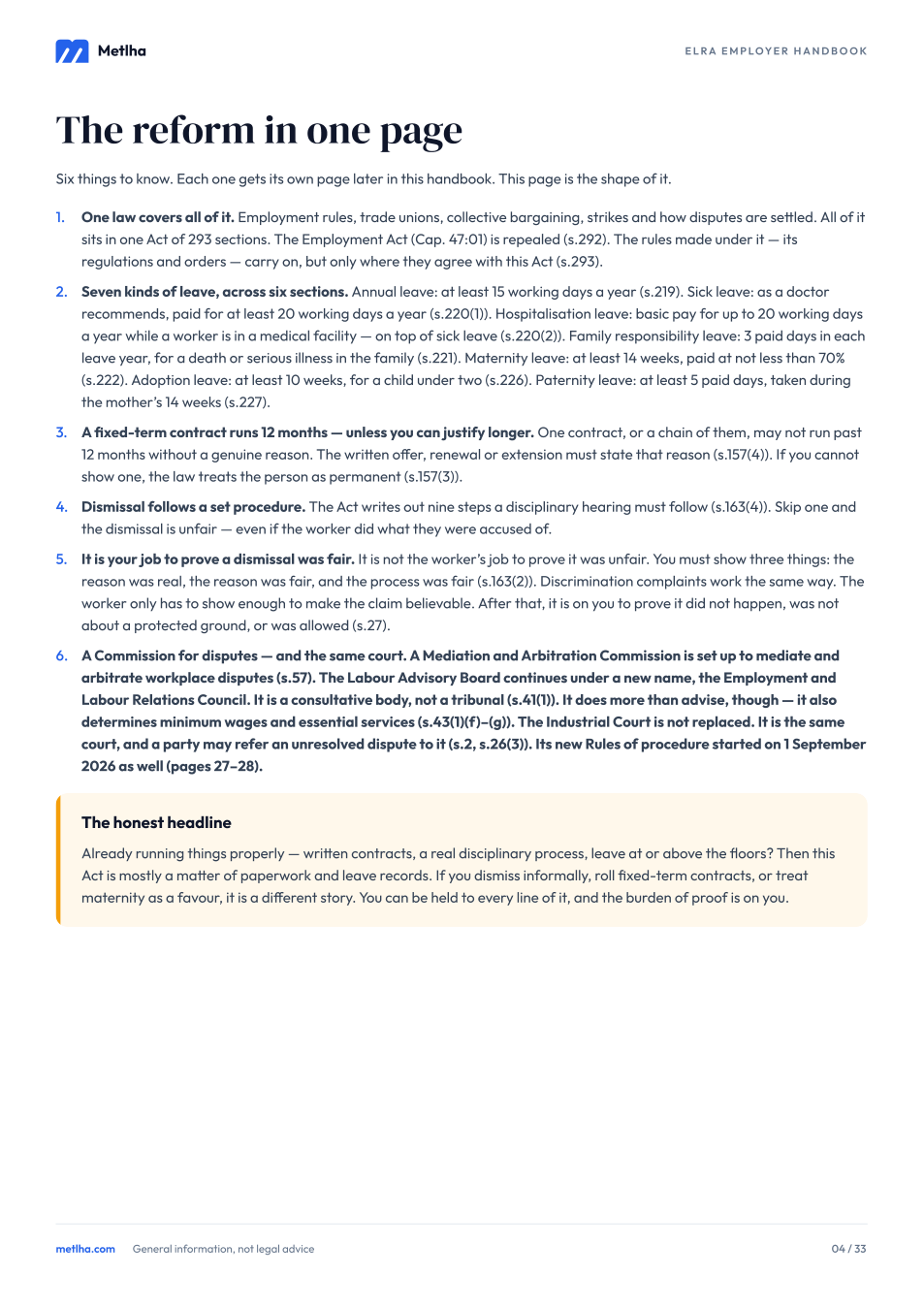
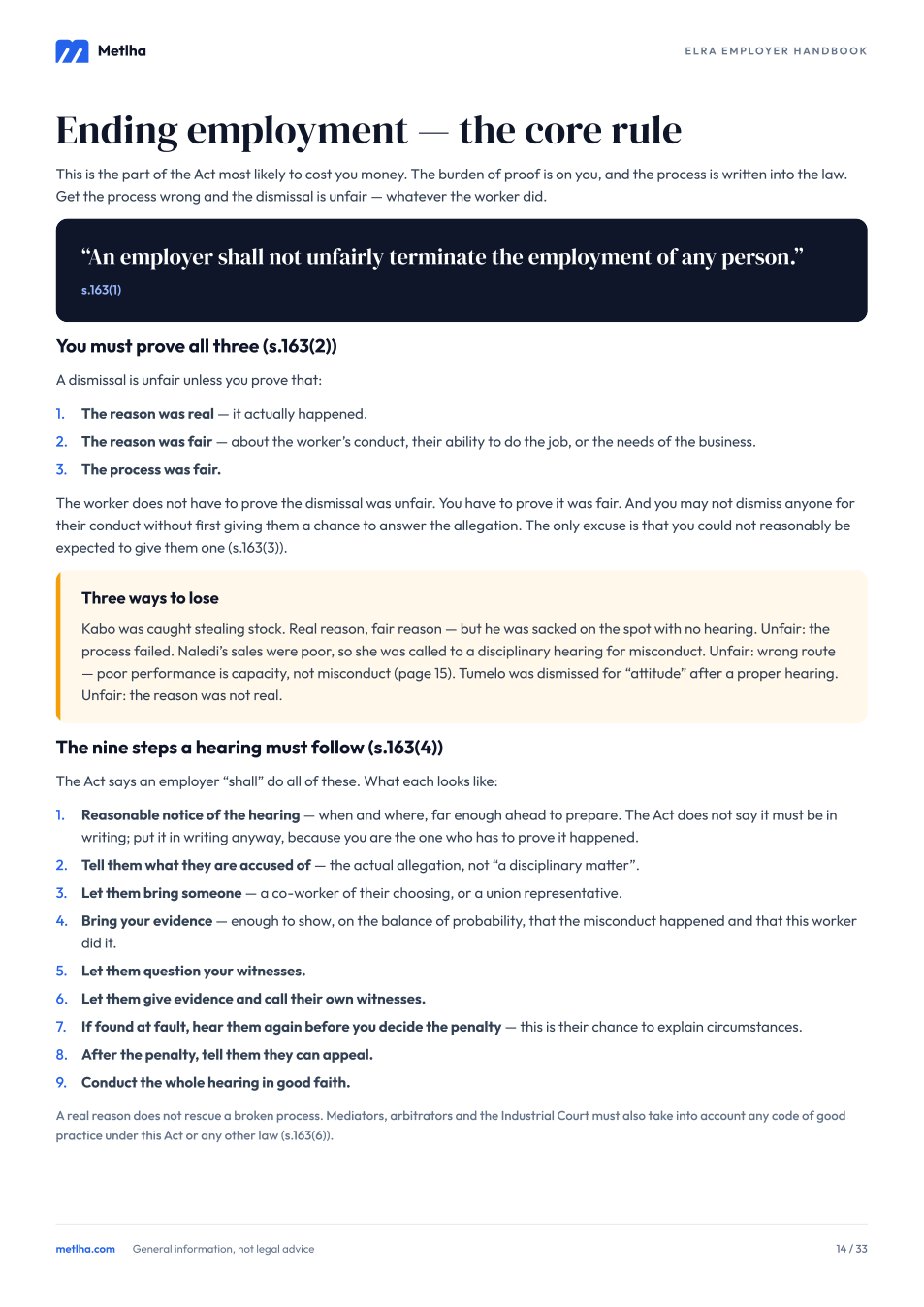
P250 · one payment
Second edition · 33 pages · PDF
Buy the employer’s handbook
Tell us who you are and we’ll send a pro-forma with our bank details. Pay by transfer, send the proof, and your download link and receipt follow within one business day.
This handbook is general information for employers, prepared in good faith by Metlha Technologies (Pty) Ltd. It is not legal advice, and buying it does not make Metlha your lawyer. For a specific situation, speak to a labour-law practitioner or the Department of Labour.
Questions people ask
- How do I pay?
- Bank transfer, in Pula. You place the order, we email a pro-forma with our bank details and a payment reference, and you pay against that reference. There is no card payment yet.
- When do I get it?
- Send your proof of payment on WhatsApp or by email and we send your download link and receipt within one business day. Most go out the same day.
- What happens when the law changes?
- Your link always serves the current edition. When new instruments are published we update the edition, your existing link serves the new one, and we email you to say what changed. You do not buy it again.
- Can I share it with my team?
- It is licensed to you for use inside your own organisation — share it with your managers and your HR people. It is not for resale, redistribution or posting publicly.
- Do you give refunds?
- No refund once your download link has been issued, because that is the moment you have the file. The two sample pages above and the contents list are there so you can judge it first.
Where the law stands
- Enacted. Act No. 27 of 2025, assented 27 November 2025. Section 292 repeals the Employment Act (Cap. 47:01).
- In force since 1 September 2026. The Commencement Order — S.I. 130 of 2026 — was published in the Gazette on 31 August 2026.
- The Regulations are published too. S.I. 129 of 2026 (31 August 2026) prescribes the severance rate, the retrenchment package floor, the night-work allowance and the employment records to keep.
- A few details remain genuinely open — we have put those questions to the Ministry of Labour directly. The handbook cites the Act’s own words and goes no further. Where the handbook and the Act disagree, the Act prevails.
Your download link always serves the current edition. When new instruments are published the edition is updated, your link serves the new one, and we email you to say so. The copy saved on your drive is not updated.
Where Metlha fits
The new law, handled in your payroll
Metlha’s ELRA features switch on with the Act — the new leave entitlements with real per-person balances, and the discipline, grievance and retrenchment records the Act expects you to keep. Set something below a statutory floor and Metlha warns you prominently; the law lets you be more generous, so the final call stays yours.
Compliance is always the employer’s, not the software’s — no tool can truthfully promise otherwise. What Metlha does is make the compliant path the easy one.